
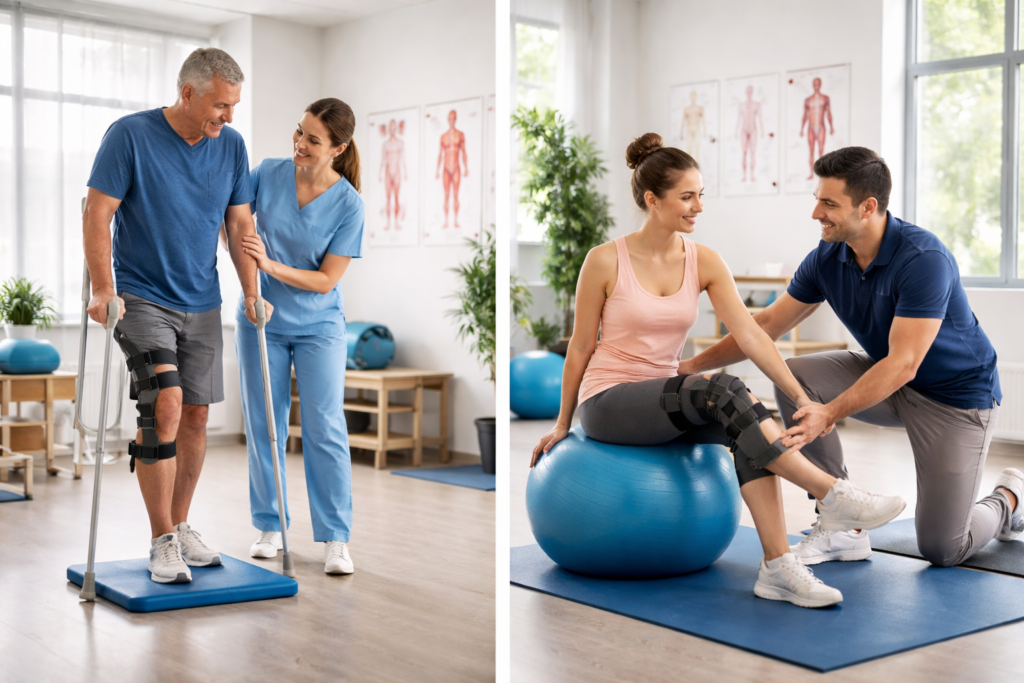
Most patients can begin post operative physiotherapy in Gurgaon within 24 to 48 hours of surgery. Getting started early reduces blood clot risk, keeps joints from seizing up, and gives your body a realistic shot at full recovery. Depending on the procedure, structured physiotherapy treatment in Gurgaon usually runs anywhere from six weeks to six months.
Surgery fixes the structural problem. What happens after — how consistently you show up, how well your rehabilitation is managed — determines whether you actually get back to living normally. Patients who rest completely after surgery, convinced the body will sort itself out, almost always find it doesn’t. Measurable muscle wasting starts within 72 hours of inactivity. Stiffness compounds quietly, day by day, until what should have been a smooth recovery becomes a slow, frustrating grind. Research on knee replacement patients is pretty clear on this: those who skip structured rehab consistently score lower on functional assessments at twelve months. That’s not anecdote — it shows up repeatedly in orthopedic literature.
A good physiotherapist isn’t just handing you exercises. They’re reading how your tissue is responding on day four and adjusting accordingly, because what’s appropriate at that point looks nothing like what’s appropriate at week seven.
When Should You Start Post Operative Physiotherapy in Gurgaon?
Earlier than most people expect. That’s usually the answer, and it surprises a lot of patients.
For most orthopedic procedures, post operative physiotherapy in Gurgaon begins one to two days after surgery. Those early sessions are deliberately low-intensity — ankle pumps, breathing work, supervised transfers from bed to chair. If you’ve just had a total hip replacement, you’ll often be standing with a walker on the first day post-op. That’s not pushing it; that’s evidence-based protocol. Early, controlled weight-bearing through a stable prosthesis actually helps bone integration and cuts down on post-operative complications.
What makes this work is communication between your surgical team and your physiotherapist before you go home. Wound status, pain levels, hardware precautions — all of it shapes what’s appropriate in those first sessions. Starting a program based on something you read online, without that clinical handoff, is one of the most reliable ways to set your recovery back by weeks.
What to Expect During Post Fracture Treatment in Gurgaon
You can’t rush bone healing. It moves through biological stages — inflammation, soft callus formation, hard callus — and trying to load a fracture site before those stages complete causes damage rather than progress. That’s just how bone biology works.
Post fracture treatment in Gurgaon is structured around those windows:
- Protection phase (roughly weeks 1–3): The main job here is swelling control, pain management, and gentle isometric work in the muscles around the fracture site. Joints that aren’t immobilized get passive range-of-motion work so secondary stiffness doesn’t creep in from neighboring structures.
- Consolidation phase: Once imaging confirms adequate callus — typically around weeks 4–6 for long bone fractures — active movement and partial weight-bearing become appropriate. Your physiotherapist should be supervising those load progressions directly, not just issuing a handout and checking in once a week.
- Functional reintegration is the final phase, and it’s not one-size-fits-all. Getting back to a desk job requires very different loading than returning to construction work or recreational sport.
Something worth knowing if you’re recovering from a fracture: six weeks of immobilization can strip more than 20% of calf muscle cross-sectional area. That doesn’t come back on its own. Rest got you through the healing window — now deliberate, progressive loading has to do the rebuilding.
How Recovery Progresses With Arthroplasty Treatment in Gurgaon
Joint replacement rehab tends to be the most involved post-surgical program, and there’s a straightforward reason for it. Your new joint doesn’t carry the sensory feedback that your original cartilage and ligaments provided. The surrounding muscles have to pick up a lot of that role, and teaching them to do that reliably takes a structured, staged approach.
Arthroplasty treatment in Gurgaon works through clear phases:
Days 1–14: Early sessions focus on swelling control, activating the key muscle groups — quadriceps for knee replacement, gluteals for hip — and building enough range of motion for basic daily tasks. If you’ve had a total knee arthroplasty, reaching 90 degrees of knee flexion by around day 10 is a reasonable clinical target.
Weeks 2–6: The program shifts toward closed-chain strengthening: mini-squats, step-ups, stationary cycling. Gait correction also becomes a priority here. You may arrive with months of pre-surgical compensatory movement habits, and those don’t disappear just because the joint has been replaced. They need direct attention.
Six weeks onward: Balance training, progressive endurance work, and conditioning specific to what you actually want to return to. If you’re going back to golf, you’ll need rotational loading and hip dissociation work. If your goal is walking comfortably on uneven ground, the program should reflect that instead.
Most patients feel a real improvement in pain and mobility by week eight. Getting both sides to function comparably — true symmetry between the operated and non-operated limb — usually takes four to six months with consistent follow-through on home exercise between clinic visits.
What Physiotherapy Treatment in Gurgaon Delivers Over the Long Term
Getting through the full course of rehabilitation matters beyond short-term comfort. Patients who complete structured physiotherapy treatment in Gurgaon show lower rates of revision surgery, fewer falls in the year following their procedure.
A well-run program includes:
- Manual therapy — joint mobilization, soft tissue release — for restrictions that targeted exercise won’t address on its own
- Neuromuscular re-education focused on the specific movement patterns the surgery disrupted
- A home program with genuine progressions, tied to what you can currently do rather than arbitrary time milestones
- Clear load management guidance, because the belief that more effort always equals faster recovery causes real setbacks during early healing — and it’s a belief a lot of patients carry
One practical thing worth flagging: if your exercise program hasn’t changed in four weeks, that’s a conversation to have with your physiotherapist. Progression should be continuous and responsive to what your body is showing, not locked into a generic schedule.
Taking the Next Step in Your Recovery
Recovery after surgery isn’t a passive process, and it doesn’t move in a straight line. There are identifiable stages, measurable benchmarks, and decision points where the right intervention at the right time changes the outcome meaningfully. Whether you’re starting post operative physiotherapy in Gurgaon, working through post fracture treatment in Gurgaon, or rebuilding after arthroplasty treatment in Gurgaon, the quality of your rehabilitation program shapes your long-term result far more than the surgery alone.
For qualified practitioners and evidence-based physiotherapy treatment in Gurgaon matched to your specific procedure and goals, visit the Physiotherapist in Gurgaon website for clinical resources and help finding the right care.