
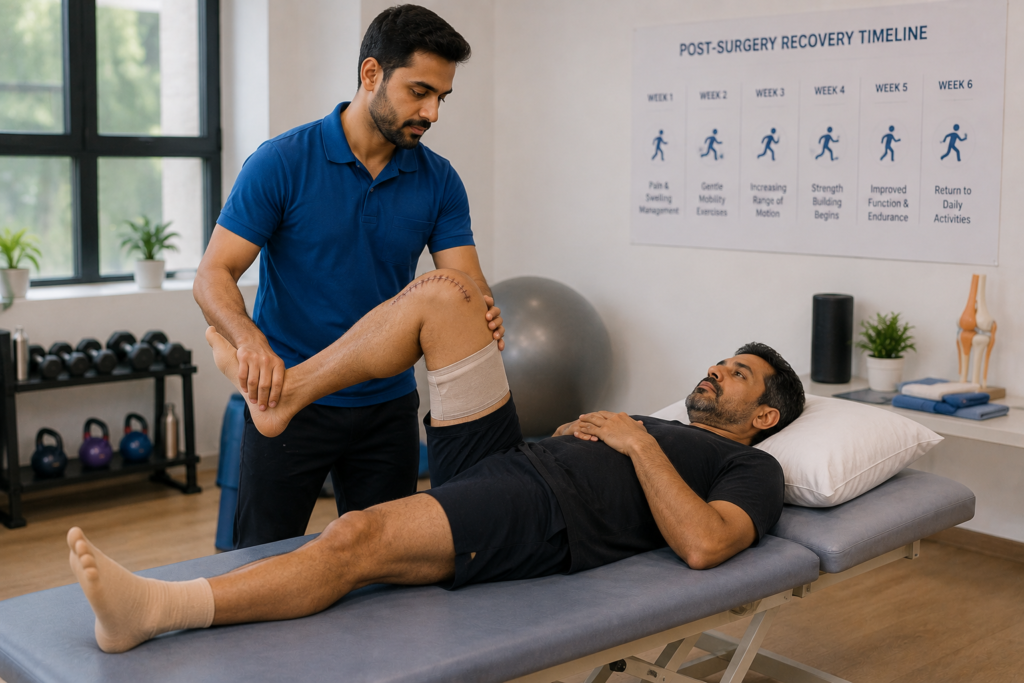
You might walk into a clinic moving fairly normally, then wince the moment you step onto a stair. Flat ground gives the knee a pass. Stairs don’t. Going down is typically worse — descending places roughly 3.5 times body weight through the patellofemoral joint, exposing problems that ordinary walking never surfaces. That loading pattern is precisely what Orthopaedic Physiotherapy In Gurgaon is built to identify and correct.
Stair pain isn’t a single condition. It’s a symptom that can arise from a handful of distinct structural or inflammatory sources, and the treatment that resolves one may do nothing for another. Misidentifying it early is probably the most common reason people spend months doing the wrong exercises and end up no better off.
What Causes Knee Pain on Stairs?
Stairs are mechanically demanding. Patellofemoral contact pressure peaks at roughly 30–60 degrees of knee flexion — right in the middle of a normal step — so any weakness in the surrounding muscles or disruption in kneecap tracking gets exposed quickly under that kind of load.
A few of the more common culprits:
- Cartilage softening beneath the kneecap, which disrupts the smooth glide of the patella across the femoral groove and creates friction with every step
- Autoimmune joint inflammation — rheumatoid arthritis being the primary example — where persistent synovial irritation degrades joint mechanics over time
- Quadriceps weakness, particularly in the vastus medialis oblique (VMO), the muscle sitting just above and to the inner side of the kneecap that keeps it tracking properly
- Valgus collapse on loading — your knee drops inward during stair descent because the hip abductors aren’t pulling their weight, shifting stress onto structures that can’t handle it well
- Old meniscus or ligament injuries that were never fully rehabilitated, leaving the joint mechanically vulnerable long after the acute pain settled
Each of these requires a different clinical response. Treating a tracking problem won’t resolve active inflammation. Addressing inflammation won’t fix a muscle control deficit. Getting the diagnosis right from the start is what determines whether the next eight weeks of treatment actually moves the needle.
Chondromalacia Patella Treatment in Gurgaon
Chondromalacia patella involves the breakdown of cartilage on the underside of the kneecap. It’s among the most frequent causes of anterior knee pain in people under 45 — particularly runners, cyclists, and desk workers who spend long stretches with their knees bent at a sharp angle.
The pain is typically a dull ache around or behind the kneecap that worsens on stairs, during squats, or after sitting for more than 30–40 minutes. You might also notice a grinding sensation when moving the knee through range.
Chondromalacia Patella Treatment in Gurgaon generally works in a few deliberate stages:
- Reducing mechanical load early — keeping pain below roughly a 4/10 during activity without stopping movement entirely. Complete rest tends to weaken the supporting muscles and prolong recovery.
- VMO-targeted strengthening through exercises like terminal knee extensions and Spanish squats, which build inner quad strength without compressing damaged cartilage
- McConnell taping to guide kneecap alignment during daily activities — short-term evidence supports its use for reducing pain during functional tasks
- Manual therapy targeting the lateral retinaculum and iliotibial band when tightness is pulling the patella off its natural track
Starting early genuinely matters here. Cartilage has a limited blood supply and doesn’t regenerate easily. Every week of continued mechanical irritation gives the damage more opportunity to deepen.
Rheumatoid Arthritis Treatment in Gurgaon
Rheumatoid arthritis operates through a different mechanism altogether. Your body’s immune system attacks the synovial lining of the joint, producing inflammation, gradual joint erosion, and pain that’s typically worst first thing in the morning or after a period of rest.
If you’re managing active knee RA, stairs present a genuine daily challenge. Morning stiffness alone can make the first flight feel formidable, and joint swelling reduces the space available for smooth, pain-free movement.
Effective Rheumatoid Arthritis Treatment in Gurgaon brings a rheumatologist and physiotherapist together rather than treating the condition in isolation. Your rheumatologist manages the systemic disease; your physiotherapist focuses on preserving joint function. In practice, the physiotherapy side typically involves:
- Gentle range-of-motion work during flare periods — static quad sets, heel slides, and supine hip flexion are appropriate starting points that don’t aggravate an irritated joint
- Low-load strengthening with resistance bands rather than heavy equipment, gradually building muscular support without generating excessive joint compression
- Targeted use of cold for acute swelling and heat for chronic stiffness — choosing correctly between these actually changes what’s happening at the tissue level
- Joint protection education: distributing load appropriately on stairs, knowing when a handrail changes the mechanics meaningfully, and what footwear adjustments reduce stress on the knee
RA doesn’t wrap up the way a muscle strain does. Physiotherapy at regular intervals — including during remission — slows functional decline more consistently than treatment that only happens when things flare up.
Orthopaedic Physiotherapy In Gurgaon
Orthopaedic Physiotherapy In Gurgaon takes a wider view of the problem. Your physiotherapist assesses the full kinetic chain — foot mechanics, ankle mobility, hip control, and trunk position — because a fault anywhere along that chain can end up expressing itself as knee pain on stairs.
A thorough assessment typically includes:
- Single-leg squat analysis to observe how your knee tracks under real load — a valgus drop of more than a few degrees points fairly directly to hip abductor weakness
- Manual muscle testing across the quads, hamstrings, glutes, and calf to locate specific deficits
- Palpation of the patella, infrapatellar tendon, joint lines, and pes anserine bursa to narrow down where the pain is actually originating
- Stair-descent observation, which often reveals compensatory patterns — trunk lean, shortened step length, hip hiking — that you may not even be aware of
Treatment follows what the assessment finds rather than a standard protocol. Physiotherapists in Gurgaon’s orthopaedic settings draw on manual therapy, dry needling, neuromuscular electrical stimulation (NMES), and graded exercise progressions — selecting tools based on what you actually need, not what’s routine.
Best Physiotherapy Treatment in Gurgaon for Knee Function
The best physiotherapy treatment in Gurgaon for stair-related knee pain tends to follow a clear sequence. Clinics that see consistent outcomes usually structure programs across four stages:
- Pain control first — manual therapy, taping, or therapeutic ultrasound to reduce symptoms before adding significant load. Skipping this step often causes patients to plateau because pain inhibits the muscle activation that makes strengthening work.
- Targeted strengthening — quadriceps and hip abductor work form the core. Research in the Journal of Orthopaedic & Sports Physical Therapy found that combined quad and hip strengthening reduced patellofemoral pain scores by an average of 40% at six weeks, compared to quad training in isolation.
- Movement retraining — correcting the specific mechanical fault, whether that’s knee valgus on loading, excessive trunk lean, or restricted ankle dorsiflexion affecting stair mechanics. Some clinics use tools like Hudl Technique to make these patterns visible so you can understand what you’re working to change.
- Functional progression — returning to stairs, then inclined surfaces, then stairs under load, advancing on clinical criteria rather than time alone.
Programs that jump straight to strengthening without first managing pain inhibition — or that discharge patients once the pain settles without checking whether the movement pattern has actually changed — tend to see higher rates of recurrence. That’s not a small detail; it’s usually the difference between a lasting outcome and a temporary one.
Finding a Physiotherapist in Gurgaon
Knee pain on stairs doesn’t have to be a permanent limitation. Whether the underlying cause is chondromalacia patella, rheumatoid arthritis, or a correctable movement fault, getting an accurate assessment shifts the entire treatment trajectory.
If you’ve been managing this yourself — avoiding stairs, relying on anti-inflammatories, or waiting for it to settle on its own — it’s worth getting a proper evaluation before the pattern becomes significantly harder to reverse. An experienced physiotherapist in Gurgaon will assess your knee function directly, tell you what’s actually happening, and give you a clear picture of what needs to change. For more information on available treatments and to book a consultation, visit the Physiotherapist in Gurgaon website.